

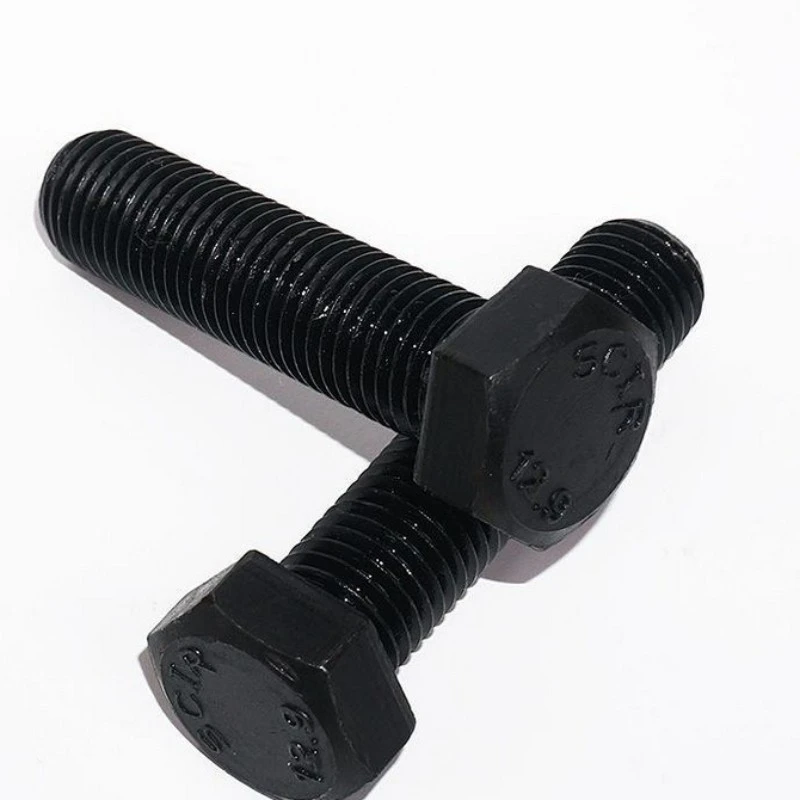
The coefficient of friction plays a crucial role in the performance and application of hex head bolts. As a leading supplier of hex head bolts, we understand the significance of this parameter and its impact on various industries. In this blog, we will delve into the concept of the coefficient of friction of hex head bolts, its influencing factors, and its importance in practical applications.
What is the Coefficient of Friction?
The coefficient of friction is a dimensionless quantity that represents the ratio of the force of friction between two surfaces to the normal force pressing them together. In the context of hex head bolts, it describes the resistance to relative motion between the bolt and the mating surface, such as a nut or a clamped part. There are two main types of coefficients of friction: static and kinetic.
The static coefficient of friction (μs) applies when the bolt and the mating surface are at rest relative to each other. It determines the minimum force required to initiate motion between the two surfaces. Once motion begins, the kinetic coefficient of friction (μk) comes into play. Generally, the static coefficient of friction is higher than the kinetic coefficient, meaning it takes more force to start the movement than to keep it going.
Influencing Factors on the Coefficient of Friction of Hex Head Bolts
Surface Finish
The surface finish of the hex head bolt and the mating surface has a significant impact on the coefficient of friction. A smooth surface finish typically results in a lower coefficient of friction, as there are fewer irregularities to interlock and resist motion. On the other hand, a rough surface finish can increase the coefficient of friction by providing more contact points and mechanical interlocking. For example, a bolt with a finely machined surface will have a different coefficient of friction compared to one with a coarse, as - forged surface.
Material Properties
The materials of the bolt and the mating part also affect the coefficient of friction. Different metals have different surface characteristics and chemical properties. For instance, steel bolts may have a different coefficient of friction when used with a steel nut compared to an aluminum nut. The hardness, ductility, and surface reactivity of the materials can all influence the frictional forces. A harder material may resist deformation and have a different frictional behavior compared to a softer material.
Lubrication
Lubrication is a powerful tool for controlling the coefficient of friction. Applying a lubricant between the bolt and the mating surface can reduce the frictional forces by creating a thin film that separates the two surfaces. This film reduces the direct contact and adhesion between the surfaces, resulting in a lower coefficient of friction. Common lubricants used for hex head bolts include oils, greases, and dry film lubricants. The type and amount of lubricant used can significantly affect the coefficient of friction.
Surface Contamination
Contaminants such as dirt, dust, rust, or debris on the surfaces of the bolt and the mating part can increase the coefficient of friction. These contaminants can act as abrasive particles, increasing the interlocking and resistance to motion. Even small amounts of contamination can have a noticeable effect on the frictional behavior of the bolted joint. Therefore, it is essential to keep the surfaces clean during the installation process.

Importance of the Coefficient of Friction in Practical Applications
Bolt Tightening
When tightening a hex head bolt, the coefficient of friction affects the relationship between the applied torque and the resulting pre - load in the bolt. The pre - load is the tension force in the bolt that holds the joint together. A higher coefficient of friction means that more of the applied torque is used to overcome the frictional forces at the thread and the bearing surface, resulting in less pre - load for a given torque. This can lead to under - tightened or over - tightened bolts, which can compromise the integrity of the joint.
Joint Integrity
The coefficient of friction also plays a role in maintaining the integrity of the bolted joint over time. A consistent and appropriate coefficient of friction helps to ensure that the pre - load in the bolt remains stable. If the coefficient of friction changes due to factors such as wear, corrosion, or contamination, the pre - load in the bolt may decrease, leading to loosening of the joint. This can cause vibrations, noise, and even failure of the joint in critical applications.
Safety
In safety - critical applications, such as in the automotive, aerospace, and construction industries, the coefficient of friction of hex head bolts is of utmost importance. Incorrectly tightened bolts due to an inaccurate understanding of the coefficient of friction can lead to catastrophic failures. For example, in an aircraft engine, a loose bolt can cause components to come apart, endangering the safety of the passengers and crew.
Our Hex Head Bolt Offerings
As a reliable supplier of hex head bolts, we offer a wide range of products to meet the diverse needs of our customers. Our Full Thread Hexagon Bolts are designed for applications where a full - length thread is required. They provide excellent holding power and are suitable for use in various industries.
Our High Strength Steel Hex Head Bolts are made from high - quality steel, offering superior strength and durability. These bolts are ideal for applications where high pre - loads are required, such as in heavy machinery and structural engineering.
We also supply Alloy Steel Stud Bolt, which are known for their excellent corrosion resistance and high - temperature performance. These stud bolts are commonly used in chemical processing plants, power generation facilities, and other harsh environments.
Conclusion
The coefficient of friction of hex head bolts is a complex and important parameter that affects the performance, integrity, and safety of bolted joints. Understanding the factors that influence the coefficient of friction and its significance in practical applications is essential for proper bolt selection, installation, and maintenance.
As a trusted supplier of hex head bolts, we are committed to providing high - quality products and technical support to our customers. Whether you need standard hex head bolts or custom - made solutions, we have the expertise and resources to meet your requirements. If you are interested in our hex head bolt products or have any questions about the coefficient of friction and its application, please feel free to contact us for procurement and further discussions.
References
- "Mechanical Engineering Design" by Joseph E. Shigley, Charles R. Mischke, and Richard G. Budynas.
- "Fasteners and Fixings Handbook" by Christopher Hoyle.
- ASTM International standards related to hex head bolts and fasteners.


